Categories
SEO

On and Off: Your brand’s guide to creating an SEO strategy

93% of all online experiences begin with a search engine like Google.

75% of users never go past the first page of search results.

Knowing such facts is one thing, but internalising them and then acting on them is what helps a brand really shine online.

SEO or search engine optimisation empowers brands to do that. The process of optimising a website to improve its visibility and rank in search engine results is known as SEO. It is a detailed plan which on execution helps a website improve its search engine ranking in order to capture more organic traffic. This plan is built on two different foundational pillars like on-page and off-page SEO. In order to fully optimise a brand’s SEO strategy, a thorough understanding of these two pillars become extremely important.

The difference between on-page and off-page is quite simple. On-page as the name suggests are all the activities done ‘on the pages of your website’. Whereas off-page means all the activities done ‘beyond the pages of your website.’ Of course it’s more than just these two lines.

Read on as Flora Fountain, a top SEO company in Ahmedabad, India, is here to help you get a better understanding of all that SEO jazz.

Let’s jump in!

On-page SEO

The process of optimising individual web pages in order to rank higher and garner more relevant organic traffic in search engines such as Google and Yahoo is known as On-page SEO. It entails optimising both the content and HTML source code of a page. From creating content with keywords, optimising title tags, meta tags, and internally linking relevant pages as per the URL structure, everything that takes place on the website falls under on-page SEO.

Content and keywords

You might already know all about content and keywords, but a refresher never hurts!

Content is indeed the king QUEEN! Most brands, despite knowing this, fail to optimise content. SEO includes looking for the keywords that your audience is using to search for information on the internet, and then creating, optimising, and regularly publishing website content around these keywords. Content also includes the kind of images you put out on your website. So you need to optimise them as well. Make sure that they are not larger than they need to be and are in the right format (JPG and PNG).

The experienced SEO team at Flora Fountain, the best digital marketing company in Ahmedabad, India, also understands how to optimise existing content, in order for a brand to increase its organic traffic.
title and meta description

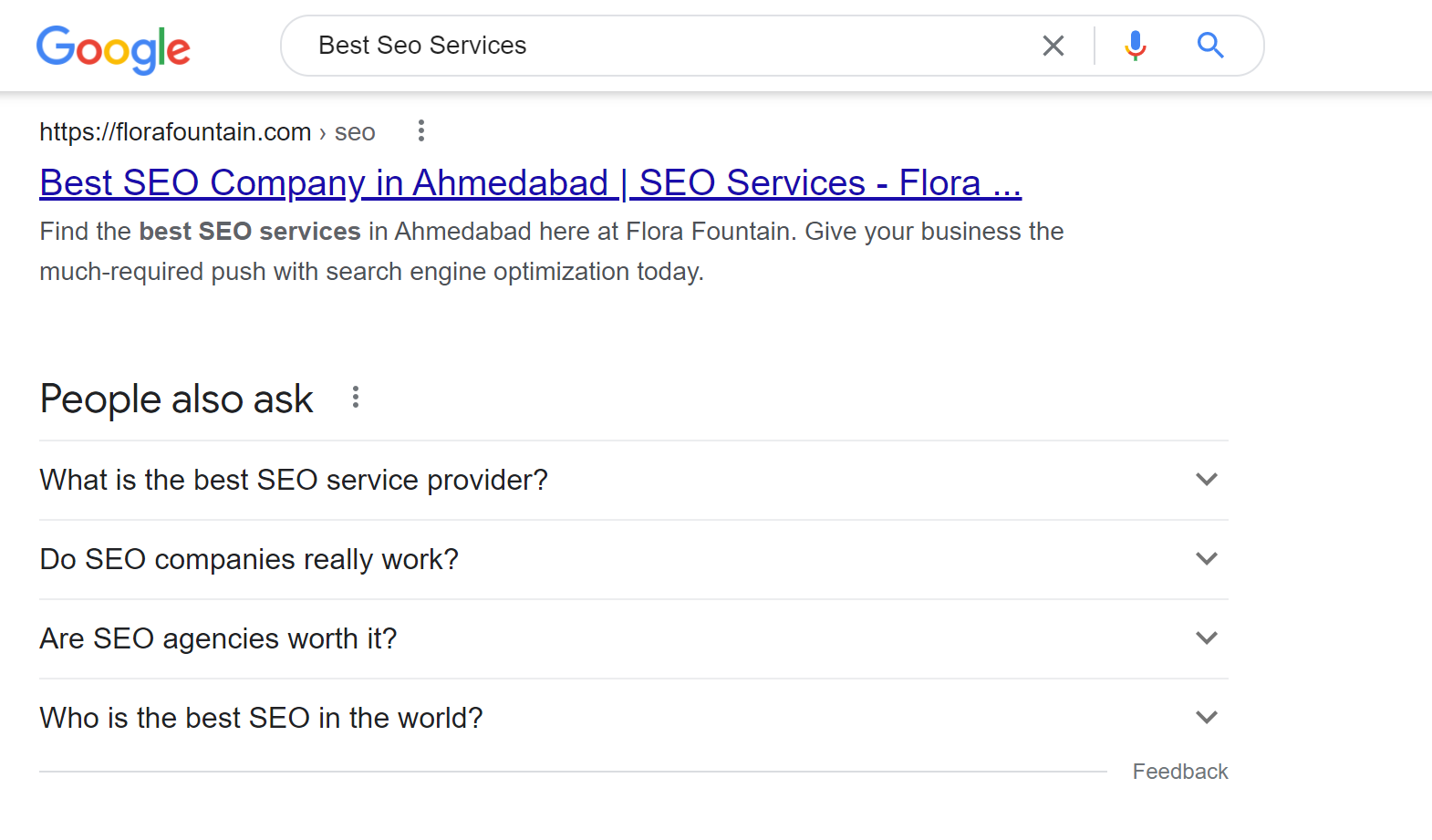
Title Tag and Meta description

The main heading or the title of the web page is a title tag. And the short description that appears under it is a meta description. Title tag comes up on the search engine results page (SERP) and is a very important factor for the success of on-page SEO. And because Google search engine usually picks up only about 65 letters or characters from the title tag, a brand needs to choose every word, even letter, very wisely! Meta tags on the other hand describe the content on that page but, more importantly, it’s written to help your web page stand out in the list of SERP results. Keep the meta description under 155 characters to ensure your entire description is shown in search results.

Internal Linking

Connecting any link from one page on the website to another page on the same website is known as internal linking. Linking to various relevant pages on the website makes it easier for search engines like Google to understand the relationship between pages on the site and to crawl everything. Internal linking also provides a more immersive user experience that can keep the visitors engaged for a longer time. Though, unlike backlinks, internal links don’t boost the website’s domain authority. But, they funnel existing domain authority built using backlinks and spread it across the website.

Mobile friendly website

A website designed to show the most optimised view as per a device’s screen size, ranging from smartphones to tablets, is known as a responsive website. The overwhelming majority of website users browse on their phones, and yet 44% brands still do not have mobile-friendly websites. Google too favours mobile-friendly websites, pushing up the ranking of the website if it is mobile-friendly. These are all the considerations that go into website development when you hire a top SEO company like Flora Fountain to work on your website re-design from day 1. Just like this Ahmedabad-based school did!

Another thing to keep in mind is that SEO results are different when it comes to mobile pages. A website does not automatically inherit the main site’s SEO ranking on mobile. The search results on mobile are calculated based on the site’s mobile page speed.

URL structure and SSL HTTPS

URL structure is a very crucial part of any website. URLs with relevant keywords allow search engines to crawl from page to page on a website very smoothly. This also makes navigation more efficient for visitors. While creating a URL, a brand should always use the primary keyword for the page and avoid repetitive words to keep it short.

Similarly, an SSL, or Secure Sockets Layer, certificate is also very important as it improves the website’s page security and visibility. With the help of SSL, the likelihood of interference of a third party in between a website’s server and a visitor’s server, decreases, guaranteeing that the content on the website is safe. Moreover, because of this search engines give ranking preference to sites that are SSL enabled.

Website Speed optimization

1,2,3,4,5! If your site takes this much time to load its content completely, chances are that 90% of users will abandon your site before the website loads. This metric is tracked as the bounce rate. And the more time your website takes to load, the higher the bounce rate. While crawling, Google correlates a high bounce rate with lower user engagement which affects your ranking as well. In fact, as per Google guidelines for developers, the site speed does impact search rankings.

So while most website design agencies might not give enough importance to this, from an SEO and user experience perspective, your website must load in under three seconds, so that with the help of SEO services and other on-page and off-page optimization, your website can come up ranking high in Google.

Breadcrumb navigation and Alt Text

Some other important parts of on-page optimisation include adding breadcrumb navigation and alt text. Breadcrumbs inform the website visitors to navigate through the site. It shows them where they are on the website. Moreover, it enables Google to understand the structure of the site. While alt text is a word or phrase that can be attributed to a picture file to help ensure it gets indexed and makes the website more accessible for reading software. Both these factors make a website with alt text for its images rank highly.

As you might have guessed, On-page SEO optimisation is something you have complete control over through your website’s code and content, however that’s not always the case for off-page SEO. So what exactly is off-page SEO optimisation?

Off-page SEO

As mentioned before, this refers to all the strategies and activities planned and executed, outside of your website, to bring traffic to it. It is tremendously valuable because it tells search engines that the website is important to others on the web. Every link that a site receives acts as an endorsement from another source. It shows the quality of the website. This is usually done through backlinks.

Backlinks

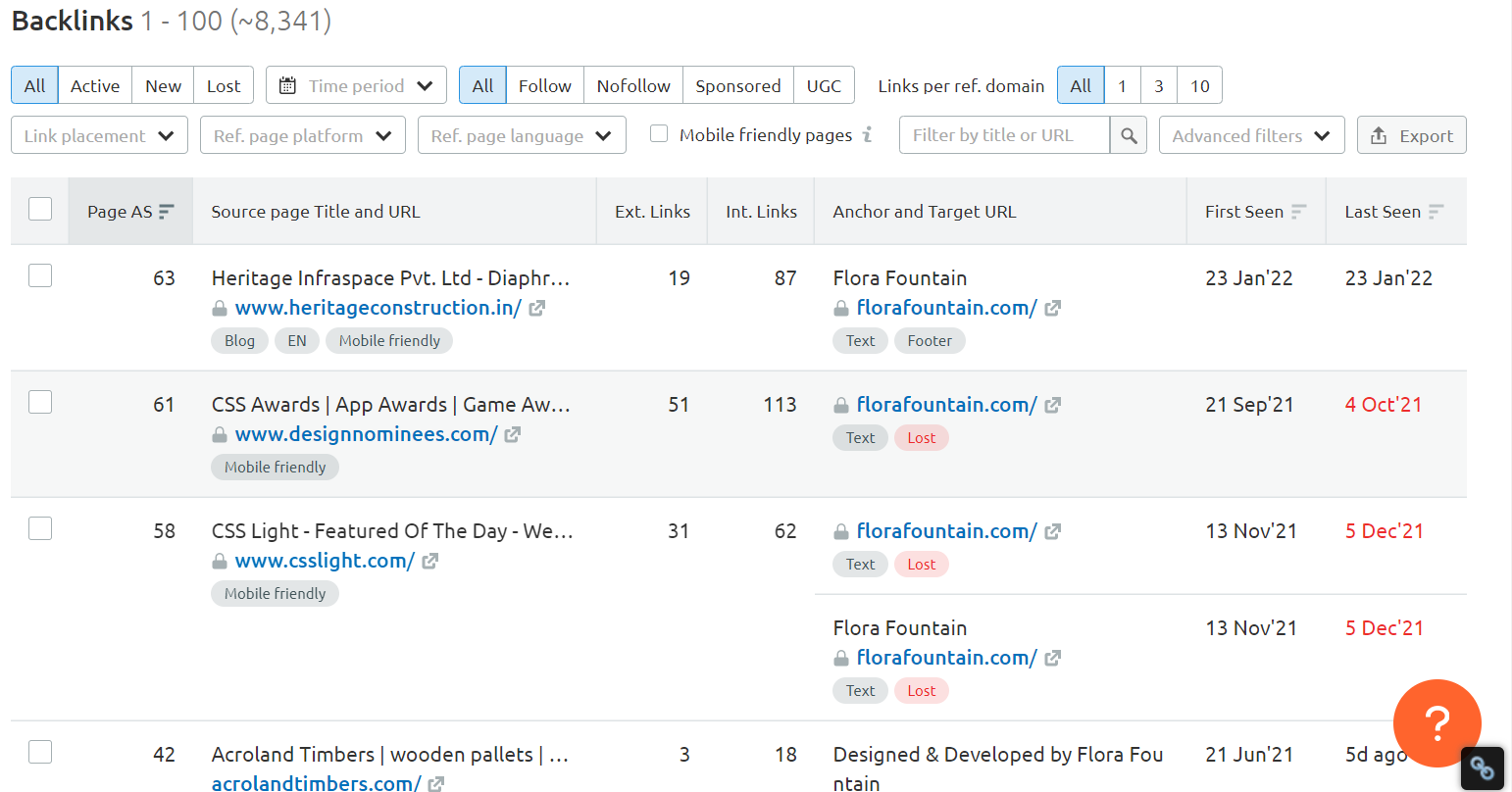
Also-known-as inbound links or incoming links, Backlinks are links that are created when one website links to another. They help a website gain more traffic and it also serves as one of Google’s top three ranking factors.

Imagine, a company with a brand new website. And no one links to it and it doesn’t submit the website Google. It can’t be found because search engines will take forever to find it, if at all. But if multiple other websites, especially those with a high ranking or domain authority, link to it, search engines can crawl through that link and index the pages. If this sounds awfully a lot like a popularity contest straight out of high school, that’s because it kind of is. Being linked to by the “popular kids” or high-trafficked websites, usually ranks your website high in search engine’s crawling eyes, and eventually bodes well for your website traffic.
Backlinks

Create. Earn. Build.

These are the three ways to get backlinks.

Creating means when someone manually adds links to their site from other sites. This can be done by regularly leaving blog comments or replying on forums. Earned backlinks or organic backlinks occur when people discover a site’s content after googling it or through social media and choose to link it in their site. This usually happens when the content on your website is rich with information or entertainment, or another quality that the reader highly values. Last but not the least, building backlinks means when a website owner contacts other website owners or editors and requests them to link to their website. This usually works as a barter between websites.

Local SEO

According to studies, more than 50% of ‘near me’ searches result in a store visit and 46% of all Google searches are seeking local information. So your brand needs to show up when someone searches for the service you provide in your area. That means you need to show up in your local google searches. But how does one go about it? With ‘Local SEO’, which helps brands to be more visible in local research on search engines like Google.

As part of local SEO, a citation is an online mention of your business on another’s website, that links not only the name but also the address and phone number of your business. It consists of your business’s name, address, and phone number or NAP. You can submit these citations to the listing sites or can hire an agency to do it for you. These citations work as proof for Google’s algorithm to find out that your brand is a local business.

Social media

Over 93% of regular internet users log into social media. So as a brand make sure to create social media accounts for your business on the platforms where you know your target group is active.

And though it is true that the likes and comments on social media don’t directly impact the website rank, it still enables you to promote your site to 93% of users who are either new or existing customers of your brand. When they see your brand on social media, they get an opening to contact you, and you get to answer them regularly.

Another thing that you can do is join hands with the right influencers and seek collaborations to promote your product or service. When influencers successfully create a buzz for your product, Google takes note of this online chatter and if there are enough shares, they’ll start to prioritise your content over others. Similarly, blog posts are a great way to put out new keywords with more recency, as blogs get indexed by search engines. In such cases, it makes sense to go with a top digital agency, with social media services, content-writing services and SEO services in-house so all the functions can work together without friction.

Reviews

It should come as no surprise that people do a fair share of research on the product they are about to purchase. And 88% of customers trust reviews posted by others online. So the more the reviews, the more your brand establishes itself as a trustworthy online brand among your existing and potential clients.

And according to Google’s local quality guidelines, responding to such reviews can improve your business visibility.

Still on the fence about SEO? Let the SEO experts, at one of the best digital marketing companies and SEO companies in Ahmedabad, India help you get a better understanding, and craft a smart and persistent SEO strategy for you. Give us a call now to inquire about our SEO services.

Categories
SEO

The Longer the Better! Why Long-Form Content Is Crucial To Effective SEO

No two writers will ever agree on the same answer when it comes to long-form content. One argument we as an SEO company offering digital services in Ahmedabad constantly battle with, is that given that the attention span of netizens is getting shorter, we must write shorter, crisp content.

But, what about the readers who wish to attain complete information, in detail from us? And of course, it will hamper the SEO activity since short-form content will never be able to touch the minimum length requirements for it.

Let’s try and understand what exactly do we mean when we say long-form content, and why it still holds importance in content marketing.

What is long-form content?

content marketing experts

There have been multiple definitions of long-form content. While some claim that any blog that crosses the threshold of 700 words is long-form, content marketing experts suggest that informative articles that are more than 1200 words are considered long-form content.

Flora Fountain’s SEO experts have always believed that any blog or article that wishes to rank higher on the search pages, must be of minimum 800 words, and should have all the relevant keywords.

And writing long-form content comes with a plethora of benefits for brands that wish to grab as much attention it wants on the internet. Here’s how…

Gain more backlinks

Backlink
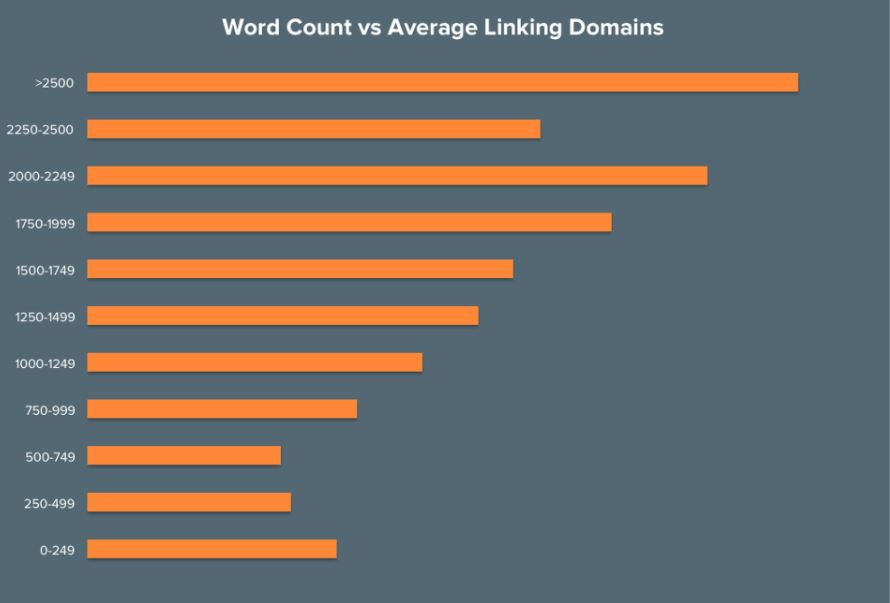
HubSpot graph showing the correlation between content length and backlinks

Google prefers high-quality content and link-building to rant any website on the search engine results page (SERP). And long-form content has a greater probability of earning quality backlinks.

HubSpot, in its research The Anatomy of a Shareable, Linkable & Popular Post found that articles with a word count of over 2500 words earn the most links. Short content on the other hand has 75% fewer backlinks than articles of average length (900–1200 words).

Drives traffic to the site

SEMrush further studied over 700,000 articles to come to a conclusion that articles with more than 3000 words generate 3 times more traffic than articles with 90-1200 words. In another study, HubSpot found that articles with 2,250 to 2,500 words earn the most organic traffic.

Here’s another fun fact that we came across. Founder of NP Digital and prominent digital marketer Neil Patel had clocked over 100,000 visitors every month in the first year itself of launching his website Neil Patel. Wondering how? Well, obviously his content is rich with data, facts and detailed knowledge about digital marketing, but apart from that, his blogs are anywhere close to 4000 words.

The point we’re making here is that when you write quality content in long-form, using the keywords strategically, search engines will definitely rank you higher and drive traffic towards your website.

Raises Click-Through Rate

Click-through-rate (CTR) is the ratio used to gauge how the keywords, advertisements and SEO listings are performing. A simpler way to explain this, is that the number of clicks an ad receives is divided by the number of times it is shown to people online. For instance, if an ad is shown to 100 people, and 5 of these people clicked on the ad, its CTR is 5%.

Search engines use this data to see if a page on a website is informative enough to the users or not. Less clicks means the page is not able to fulfill users’ query. So, they move the page down in the search rankings.

And when writing long-form content, it gives enough room to write compelling headers, description tags, and place multiple keywords on strategic locations of the write-up. These smartly written titles, headers and descriptions, peppered with keywords entice the user to click on it when shown of the SERP. And once pulled in, it can also reroute them into exploring the multiple offerings and pages on the site.

Increases dwell time

Dwell time is the amount of time any visitor spends on a particular site. This metric shows Google if a website or any page on the website is worth spending time on or if that page is fulfilling the needs of the user. If a website has a short dwell time, Google finds it irrelevant to the search query.

Long-form, good quality content gets more eyes on the page. It increases the dwell time as people stay on the page for a longer period of time.

Tips to write long-form content

  • Avoid writing in long-drawn sentences. Break down the information into shorter sentences and then place them into a paragraph.
  • Try listicles (Thank you BuzzFeed). People LOVE lists! Instead of big blocks of paragraphed content, list out the points and write shorter descriptions for them.
  • Set a flow for the content. For instance, decide a specific number of words for the opening, the introduction to the topic. Number the bullet points that cover the soul of the story and again fix a specific number of words for description of each.
  • Add source links to every study and research quoted in the article, helps with the back-linking.
Categories
SEO

Here’s How to Retain SEO Ranking even after a Website Redesign

SEO (Search Engine Optimisation) Rankings are sensitive and are prone to changing every time there is a change in the design or content of the website without planning for SEO. During a website redesign or redevelopment, there is a high risk of the website losing its organic traffic, rankings and sales.

While there are plenty of blogs and conversation online revolving around how to make a website rank higher up on the search engine results pages (SERP), very few talk specifically about maintaining those rankings, even in the event of a redesign on the website. So, let’s talk about retaining a website’s rankings on the SERP after a redesign on the site and look at some of the tips shared by the SEO experts at Flora Fountain, a digital agency offering SEO Services in Ahmedabad.

search engine optimization

Save the original website’s data first

One of the ways to ensure website’s rankings don’t suffer heavily is by maintaining a similarity in the flow of content and design of the old site. Because search engines rank those pages or websites higher that are easy to navigate. It is important to save the old or current website’s data, i.e. a list of all the pages, its URLs, important pieces of content, keywords and the sitemap for future reference. It helps the developers and designers to ensure the user experience doesn’t get disturbed on the redesigned website.

Don’t make changes on the live site

This is an important point to remember. While making changes or during the redesigning process, the website must be disabled. The updated version should be made live only after testing. But disabling a website means the business will lose many customers and visitors who might be trying to access the site. It is advised to do it on a different domain. Experts providing top SEO services in India suggest that all the changes and updates should be made in a different domain or a staging site, and once all the changes provide satisfactory results in testing, only then the new site be swapped with the old one live on the internet.

Use 301 Redirects

301 Redirects

When there is a change in the URLs, make sure to have 301 Redirects for them. The 301 Redirects notifies the search engines that the content has been shifted to a new location and takes the visitors to the new web page from the old one.

A broken link can damage the ranking of the website, which will eventually lead to losing organic traffic to the website. This happens because the search engine assigns the existing ranking to the new page only after it knows that both the pages have the same content in them.

Check for broken links

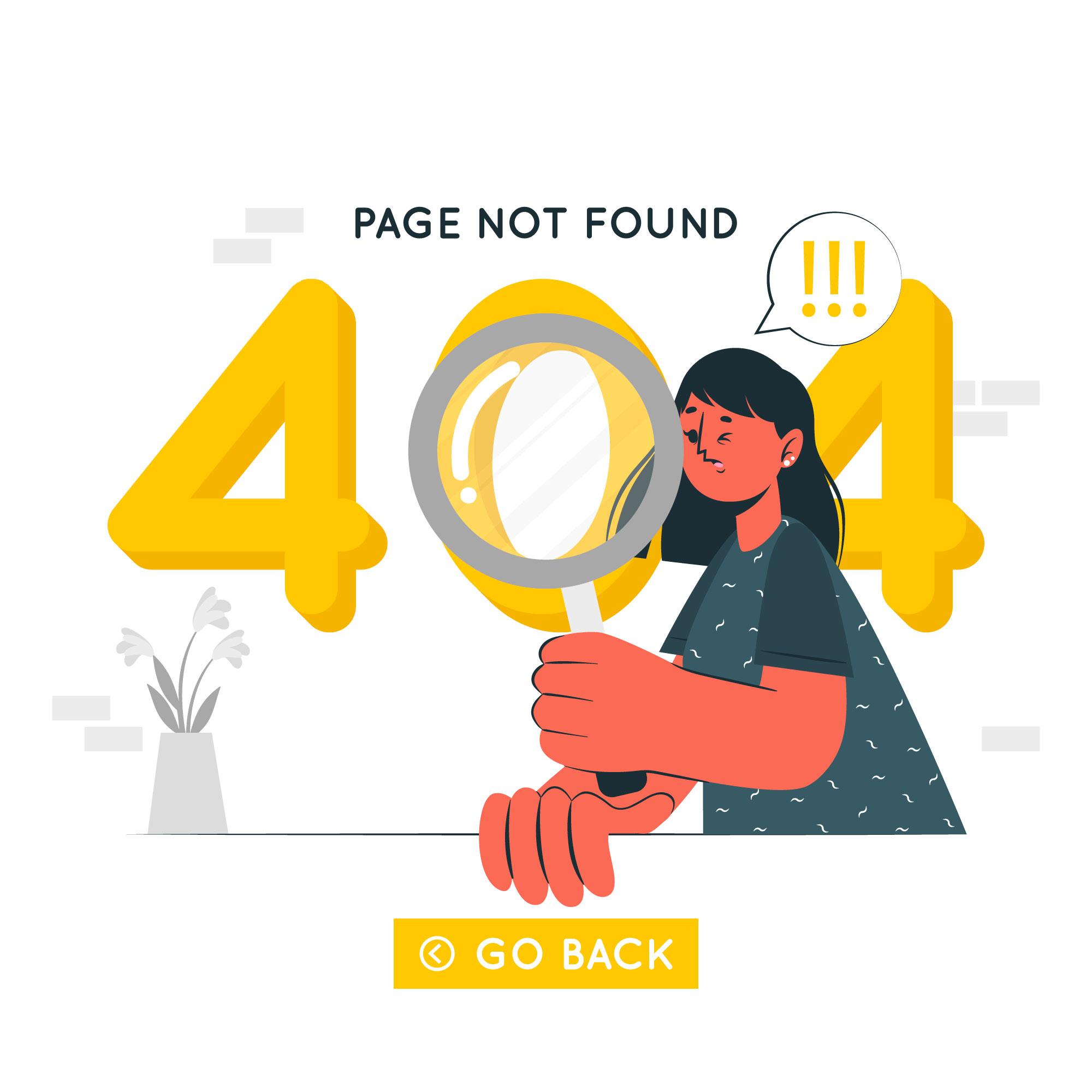
Even upon setting up 301 redirects for the pages, problems can still arise. Broken links can show up if there is a mistype or a spelling error in the URLs. And when this happens, visitors and search engines will see a page with the message “404 Page Not Found”. This again creates a bad experience and can be a serious turn off for the visitors. This error damages user experience and search rankings of the website as well.

Look for broken links on the website by using tools like Screaming frog, Bing Webmaster, Broken link checker and Yandex Webmaster.

404 Page Not Found

Reinstall SSL Certificates

Redesigning a website can result in loss of the site’s Secure Sockets Layer (SSL) certificate. And websites with SSL certificates have added advantage on the SERP. Safety and data privacy play an important role in ranking of a website as it gains people’s trust. SSL creates an additional layer of safety that protects the information people choose to share with a website. In other words, it is a protocol used to encrypt communications.
So, every time there is a redesign on the website, it is important to reinstall all the SSL certificates to ensure that the new site starts ranking up on the SERP quickly after going live. Here’s a easy to understand tutorial on how to install SSL certificates on the website

Update the Sitemap

The sitemap is an XML file that’s contains a list of the website’s URLs which helps search engines to know about the pages of your website for crawling. While redesigning a website, it is recommended to create a new sitemap XML document, as it helps search engines to index the website faster. Moreover, it allows site visitors to easily navigate it. An XML sitemap can be submitted to search engines such as Google, Bing, etc. through webmaster tools like Yoast or Sitemap Generator.

Update the Google My Business page

This might sound like a small step, but it is a crucial one. As soon as the updated website is live, the first thing to do is make changes to the Google My Business Page of the business.

Google My Business is an effective tool for businesses to use to improve their local search rankings. It can give local service-based businesses the exposure they need to be at the top of the SERPs in their area.

You don’t want to sabotage your SEO rankings while redesigning the website, do you? Let the Best Digital Agency in Gujarat help your business in retaining them. Drop us a message on hello@flora.ffteam.in

Categories
SEO

Reasons why your website must be SEARCH ENGINE OPTIMIZED

What did you do the last time you wanted to look for a doctor around you, or check out a good place that could home deliver your favourite Baklavas on order? You asked Google about it.

Over 90% of the searches on the internet are done on Google and there’s only a 5% chance that we go beyond the results shown to us on the first page of the search window.

businessman-looking

And if you’re a brand that wants to be the first option of your consumer base, then you must feature on this first page every time someone searches for your name or a product or service you offer. The only way to be placed on top of the searches organically is through SEO, or Search Engine Optimization.

Wondering what is search engine optimization all about and how is it going to help your business or brand online? Here’s everything you need to know.

What is SEO anyway?

Search Engine Optimization or SEO is an internet marketing strategy where you improve the quality and quantity of your website based on the relevance of what your consumer base is looking and searching for on the internet.

The content on the website is optimized in a manner that ranks higher on the search engine pages of Google or Bing. And when someone looks for something which is even closely connected to your content, it shows up on the top of the search results.

applications-be-connected

And this optimization is done by putting up content that’s very relevant to what people are searching for, feature media that’s labelled correctly, contains references and links which support and make sense to the content, and contains the right amount of keywords and phrases which people use to search for your content.

And if you’re still not convinced on how SEO is going to help your business online, here we provide you with 5 benefits of having a website that’s Search Engine Optimized.

Improve Brand Visibility online

We’d like to start with an absolute no-brainer. Just imagine, you are a business that sells premium quality tea through your ecommerce website. While your business and its website appear on top of the search window every time someone looks up your brand name specifically, but whenever someone searches for “premium tea”, it’s your competitor’s name that pops up first. So frustrating, right?

This wouldn’t happen if you use the right keywords which people use to look for your product and service and link it to your website. This way, your brand name features on top of the search results and it gets etched into the minds of people who search for products and content related to your brand. The higher you rank on the search results, your brand’s visibility gets better.

Drive organic traffic to your website and convert them into sales

Apart from improving the visibility of your website, SEO also drives genuine visitors to your website, who hold a higher chance of getting converted into a paying customer for your product or service.

When you use original content, insert the right keywords, use genuine links to establish the authenticity of your content, and provide exactly what your customer is looking for, it is going to show up on the search screens on top.

Understand what and how your consumer thinks

Search Engine Optimization begins with research, about the consumers of the product, their background, their interests, and the time they spend on the internet seeking what they like. And with the data that this research throws up, you can understand the language that your probable customers are talking about and where do their loyalties lie when it comes to a certain product or service offered by multiple brands.

woman-casual

This helps in using the right keywords in your website, creating content for your website in a language that your consumer base will understand, and keeps them hooked on to it for a longer duration. This, in turn, increases your chances of converting them into a customer.

At the end of the day, your customer is the king and you must create and provide what they wish, and not what you want them to use. And search engines will push only the former on top.

No paying for “Ad Space”

No, you never have to pay Google, or any search engine to rank your website on top of the search results. The positions you see on the results page of the search engine are purely based on who did their SEO perfectly and ticked all the boxes.

We know, you might argue that what about the search results one gets to see with a tiny marker which reads “Ad” in black. They are Google Pay Per Click ads which, just like the name, are paid, advertised links of websites that pay a sum to google for every time someone clicks on that link.

They are not connected to SEO anyway, and all the results you see beneath those links, are purely organic. So technically, if you’re doing your SEO right, you never have to pay for an “ad space” for visibility like businesses have to do with OTT advertising.

Improves credibility of your business

A website that ranks on top of the charts of the search window tends to hold over 70% attention of the viewer compared the ones even in the 2nd or third position. It goes without saying that most of us won’t even bother clicking on the second page to see what more options do we have.

The credibility of brands that rank in the first 5 results is always higher compared to the others. Which means if your brand has done its SEO right, people will prefer clicking on your link if they see it first. This way only the right people get targeted, it results in higher organic footfalls on the website and in turn have a higher chances of getting converted into a valuable lead for the business.

Stay ahead of your competitors

And of course, when you’re on the top the charts every time someone searches for something, you’re miles ahead of your competitors. Just like we mentioned in our first point, you’re able to beat your competitors if you use the right keywords and links that connects with your business, and your visibility is going to peak higher than all.

And if you’re wondering whether your website is SEO friendly or not, how about you drop us a line here for a free consultation with our SEO expert.